

First of three pieces on what the hobbits inherited, and what they did with it. Each stands on its own.
To inherit something is a good. A house that was your grandfather’s, a name that was carried before you were born, a place at a table that was set long before you could reach it.
These are gifts. Nobody earns an inheritance. It arrives because of who you belong to, and it says, before you have done anything at all, that you were expected and someone has made room for you.
And yet the same inheritance can elicit very different reactions from people. One may see it as a means to stay connected to those who have passed on. Another as what was owed to him. A third cannot wait to be rid of it, and a fourth never expected it and receives it as a surprise. The inheritance can be identical, but what is different is the hand it was placed in.
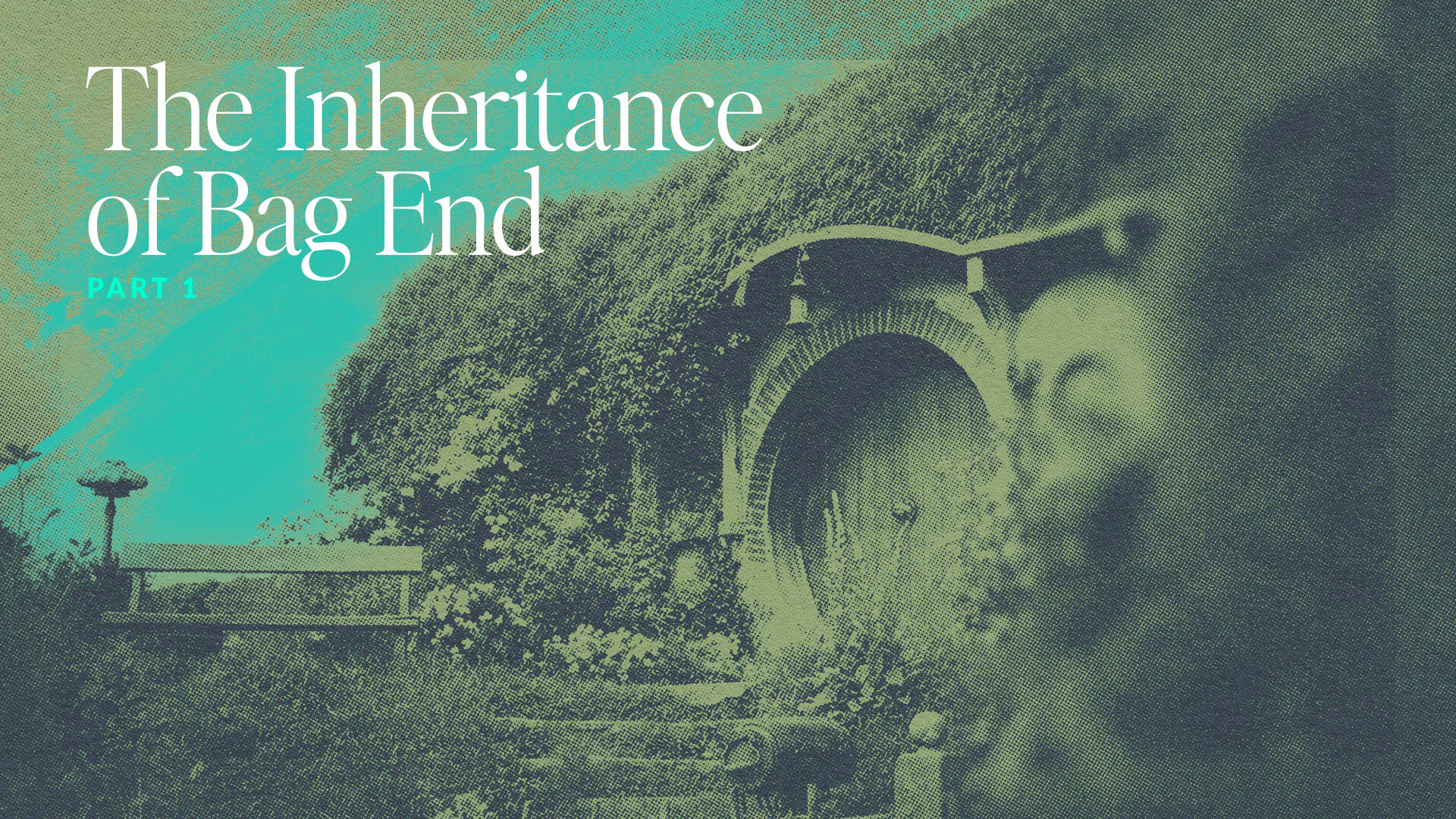
Bag End. Tolkien bookended a whole story around a hobbit-hole and the question of who it belonged to. It has a name, a family who wanted it and did not receive it, an heir who gave it up, and a gardener. Before the Ring, before Mordor, before anyone had spoken of a Dark Lord, The Lord of the Rings opens with a birthday party and a will. And it ends with the passing on of what symbolizes “home.”
THE ELEVENTY-FIRST BIRTHDAY
Hobbits don’t receive presents on their birthday, they give them away. All who come to the party leave with something. Many of the gifts are what Tolkien calls mathoms, “anything that Hobbits had no immediate use for, but were unwilling to throw away.” The hobbit remedy for a thing he could neither use nor discard was to give it to a neighbor.
When Bilbo Baggins turned one hundred and eleven, he kept the birthday custom for the whole district. Every guest went home with a gift, and some of the gifts carried a message. Lobelia Sackville-Baggins received a case of silver spoons, labeled as a present. Bilbo had long suspected her of stealing his. He meant the gift as a rebuke.
Then he gave his speech, put on a ring, and vanished in front of a hundred and forty-four guests. He had already arranged the rest. Bag End and everything in it went to Frodo, his young cousin and adopted heir, and the will was in order.
Consider what that evening amounts to. A man at the end of a long life spends his last public hour handing things over. Everything he had gathered in a hundred and eleven years goes out the door in other people’s arms, and then he goes out the door himself, with a pack. He does it cheerfully. He does it with jokes. The generosity has no strain in it, because the custom he grew up inside taught him that a birthday is the day you give, because your life is a gift.
There was one thing that was difficult to leave behind, which Gandalf saw as the only point of the whole affair. We’ll return to this shortly. But first, let’s take a moment to blow smoke rings with the people who wanted the hobbit hole.
THE NAME OF THE HOUSE
Bag End has its name because the lane up the Hill ends there and goes no further. In the notes he later wrote for translators, Tolkien glosses Bag End as “the end of a ‘bag’ or ‘pudding bag’ = cul-de-sac.” It is a homely name for a homely place. It says: this is where the road stops and someone lives.
The relatives who coveted it were the Sackville-Bagginses. Tolkien chose that surname deliberately. The same notes call Sackville “an English name (of more aristocratic association than Baggins),” joined to Baggins “because of the similar meaning in English… sack and bag, and because of the slightly comic effect of this conjunction.”
So the family name says the same object twice, once in the homely word and once in the word that puts on airs, or wants to at the expense of others, as Otho and Lobelia Sackville-Baggins did. A Sackville-Baggins is a Baggins who would prefer you to think otherwise. The social climbing is in the surname before either of them has spoken a line. This is not the sort of dignity that can be properly associated with an aristocratic life, one that the elves embodied. No, you could feel Tolkien mocking the self-importance and entitlement of the Sackville-Bagginses over and over again.
Had Bilbo never adopted Frodo, Bag End would have gone to Otho Sackville-Baggins. And so the two of them arrived after the party with a claim rather than grief. They demanded to see the will, and it held. It was, the narrator tells us, “unfortunately, very clear and correct.” Otho relented. Lobelia lingered, searching the rooms, until Frodo escorted her out himself, taking back on the way “several small (but rather valuable) articles that had somehow fallen inside her umbrella.”
Tolkien mocks them through several of the voices available to him. Bilbo’s mockery is in the label on the spoons. Frodo’s comes after Lobelia’s parting shot, that he is no Baggins at all, only a Brandybuck. He closes the door on her and says, “Did you hear that, Merry? That was an insult, if you like.” Merry answers that it was a compliment, “and so, of course, not true.”
The narrator joins in with every “somehow” and “unfortunately.” Within the story, that narrator is Frodo. Tolkien frames the whole book as taken from the Red Book of Westmarch, the memoir Bilbo began and Frodo carried on. The hobbit who showed Lobelia the door is the one telling us about it.
Sit a moment with their grievance. The Sackville-Bagginses had been promised nothing and Bilbo owed them nothing. The house had been his to dispose of, and he had disposed of it. And still they experienced Frodo’s inheritance as a theft, because in their minds the house had already been theirs for decades. They had been measuring the rooms ever since the day Bilbo departed with the dwarves and was presumed dead. Wanting the house had quietly become confused with being owed it. Their desire had turned into a deed.
That is a recognizable disposition, and it does not need a Ring to produce it. A person comes to believe that the strength of his wanting constitutes a claim on the thing he wants, so that another person’s legitimate possession of it becomes an injury done to him. This is covetousness. This side of the family was grasping, almost needy for what they believed was owed to them. And it essentially kept them divided from what should have been a close family connection. We will meet an unadulterated form of this covetousness further on in the story, in a place with no spoons and no umbrellas. For now it is enough to see that it was already living in the Shire, in a respectable family, under a double-barreled name.
TWO FAMILIES IN ONE HOBBIT
Bag End was a Baggins house, and its owner was only half a Baggins. Tolkien tells us in the first pages of The Hobbit what each side meant. The Bagginses were respectable, and their respectability was predictability: “you could tell what a Baggins would say on any question without the bother of asking him.” The Tooks were richer and less respectable, and every so often one of them set out on an adventure while the family said nothing of it.
Bilbo carried both. For fifty years the Baggins side was dominant, and he lived a comfortable and predictable life. Then thirteen dwarves sat in his parlor and sang of gold under the mountain, and Tolkien writes that “something Tookish woke up inside him, and he wished to go and see the great mountains.” By the next morning the Baggins side had reasserted itself and he was relieved to find the dwarves gone. Gandalf had to hurry him out the door before the Baggins in him could talk him out of it.
Two parts of himself, both inherited, both good. The Baggins in him loved home, order, second breakfast, and the sound of the kettle. A song about mountains stirred the Took in him. Neither is the enemy. A person who had only the first would never leave, and a person who had only the second would never have anywhere to come home to. What Bilbo had was both, at odds, inside one waistcoat.
When we use the term “part” in clinical language, we do mean those aspects of the person which are distinct. They may be in disagreement, but they each carry something they learned to value. Each is certain it knows what the whole person should do. The Baggins part and the Took part were at odds because each was protecting a real good and did not trust the other to honor it. The deep work is to make space for the perspectives of both, and to act in freedom with what is true of each. Bilbo spent a year on the road learning to do exactly that, and came home a hobbit the neighbors found harder to predict.
The same two families run through Frodo. His mother was a Brandybuck, and her mother was a Took, a daughter of the Old Took and sister to Bilbo’s own mother, as a hobbit would be happy to explain to you. So when Lobelia declared him no Baggins at all, only a Brandybuck, she was sneering at the very inheritance Bilbo had spent a year learning to trust. Her insult assumes that Bag End belongs to whoever is most purely a Baggins. The part of Frodo that could hear the road is the part that would one day let the house go.
WHAT HE COULD NOT PUT DOWN
Now return to the night of the party, to the one thing Bilbo found hard to leave behind.
He had given away the house without a tremor. The spoons, the furniture, the land. He had arranged for all of it to pass out of his hands, and none of it cost him anything. The Ring was another matter. He had told Gandalf he would leave it for Frodo along with everything else. When the moment came he sealed it in an envelope, and the envelope went into his pocket rather than onto the mantelpiece where he had said it would go. Gandalf noticed. He asked Bilbo to do as he had promised.
What followed is the first time the reader sees the influence of the Ring. Bilbo grew angry. He accused Gandalf of wanting it for himself. And then he said a thing that stopped them both. “It is mine, I tell you. My own. My precious.” Gandalf then noticed the hold that the Ring had taken upon him, stirring up within him that covetousness. The wizard helped his friend come to his senses, and so Bilbo took the envelope out, and tried to place it on the mantlepiece for Frodo. His hand refused to set it down. The packet fell to the floor, and Gandalf had to be the one to leave it there. Then Bilbo shouldered his pack and stepped out into the night. “I am as happy now as I have ever been,” he had told Gandalf, like a hobbit who had just put down a weight he did not know he was carrying.
A possession is a thing we have. An attachment is a thing that has us. Bilbo could hand over a house because the house had never become part of him. It was his and it was good, but it was a thing, and things can be given. The Ring had gone further in. Over sixty years it had stopped being an object in his pocket and become something closer to a piece of his own hand, so that letting it go felt less like generosity than amputation. Earlier that same evening he had told Gandalf that he felt “thin, sort of stretched… like butter that has been scraped over too much bread.” That thinning is the Ring’s work in a person, and it comes from the one thing he could not imagine giving away.
The ease with which a person can hand something on shows what that thing has become to him. Bilbo’s party gives us that measure, and we can hold it up to ourselves: what we could give away tomorrow with a joke and a label is still ours, and what we would fight a friend to keep has begun to own us. We here the echoes of Aragorn here, when he affirmed Pippin for leaving his Lothlórien brooch behind, “One who cannot cast away a treasure at need is in fetters.”
THE HOUSE CHANGES HANDS
Seventeen years later, Frodo sold Bag End.
He needed a reason to leave the Shire that no one would question, and he needed money for a house in Buckland that he never intended to live in, and so he sold the hole his cousin had left him to the very people who had wanted it all along. Lobelia Sackville-Baggins was a hundred years old and had waited seventy-seven of them for this. She took the keys. Tolkien lets her have a moment of triumph in the doorway, and it is a small and sour thing, because by the time she has the house the story has already left it.
Notice Frodo’s freedom. He had been given a thing, and a thing can be let go, and when the road asked for it he let it go. He could have kept it for Bilbo’s sake. He could have kept it for the pleasure of denying it to the Sackville-Bagginses. Either would have been understandable. He let it go. He was his uncle’s heir in the manner that counts, and it was a manner he chose. The stance had passed down along with the deed.
Lobelia had finally come to possess the house. She had it at the precise moment the story walked out of the front door and down the lane, and the reader never sees her enjoy a single evening in it.
Two hands, then, in the first hundred pages. Frodo’s opens without strain, and Lobelia’s closes on what she believes she is owed. The same house passed through both, and the house did not change. The people holding it were revealed.
There is one more thing that came out of Bag End that night, and it concerns the concept of inheritance for the rest of the story. It fit in a waistcoat pocket. It had come to Bilbo in the dark under a mountain, from a creature who also believed a thing was owed to him on somebody else’s birthday. But the Ring is not the only thing Bilbo carried out of that darkness. He carried out two things, and the second one is the subject of the next piece.
Continued in Part 2: The Dark, on what Bilbo found under the mountain, and why the Ring’s first temptation is to make a person disappear.