

Most of us have felt the pull at some point.
When the world gets too loud, the relationships too complicated, something in us just wants to go quiet, to shrink the radius down to something manageable, to stop returning calls, to close the door. That impulse is not pathological on its own. It’s human.
Most of us have also, at some point, seen it happen to someone we love. We watch the gradual retreat, the narrowing, the person becoming harder and harder to reach, leaving us with the particular helplessness of not knowing how to get through.
Tolkien gave us a complete portrait of what that looks like when we follow isolation to its conclusion.
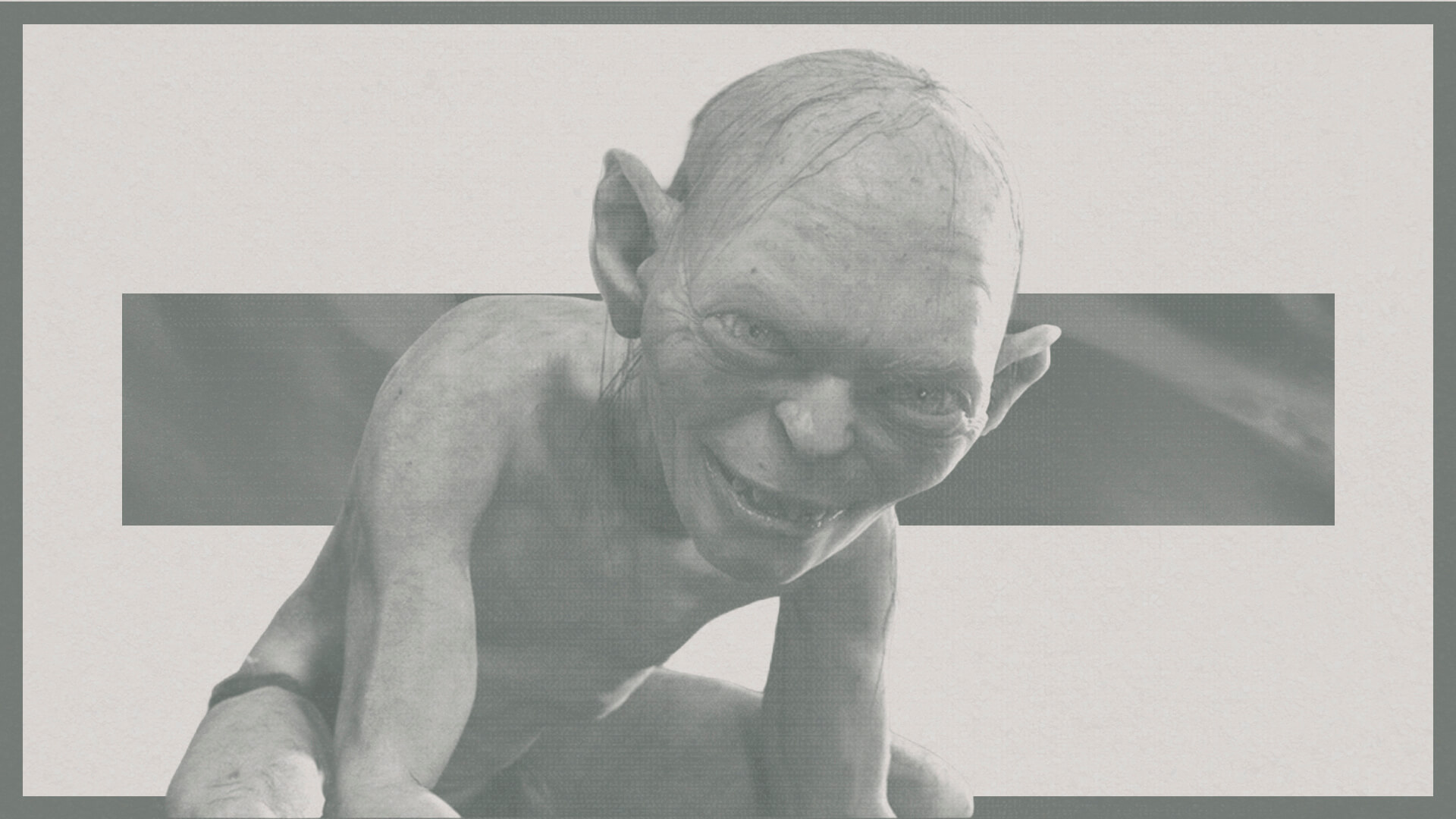
His name was Sméagol. Most of us know him by the other name — Gollum, the villain that he became. But Tolkien preserved both names all the way to the end, and this tells us that he was writing about a wound, rather than a monster.
The easy reading is that the Ring corrupted him, full stop. But the more carefully we read what Tolkien actually gives us, the more that it becomes clear that this reading lets us off the hook too quickly, not from pity, but from something more uncomfortable: the recognition that Sméagol’s story didn’t begin with the Ring at all.
The Wound Before The Fall
Before the Ring, before the creature, there was a hobbit who was already rejected by his own people. Tolkien’s Gandalf tells us plainly, in that second chapter of The Fellowship of the Ring, that Sméagol “had no friends.” His curiosity, the very thing that could have made him remarkable, was met with suspicion rather than delight. His kin found him queer and unpleasant. He spent time alone, prying and peering at things others didn’t notice, accumulating small knowledges and filing them away in private. A child whose way of being in the world provoked distance rather than welcome.
When a person meets rejection early and often, the psyche adapts. In the language of Internal Family Systems, parts of the self begin to take on extreme protective roles: managing vulnerability, foreclosing exposure, keeping the wound of unmet need safely buried. These parts are not pathological by origin. They are ingenious. They are a child’s best available response to an environment that could not receive them.
But over time they do not stay ingenious. They become compulsive. They organize a life around avoiding the wound, and in organizing that life, they produce the very isolation they were designed to prevent. The person is not alone because they chose to be. The person is alone because their own defenses drove everyone away, and then calcified.
The isolation is secondary. It has its own momentum, certainly. But it is secondary.
This is not, in the first instance, a Ring problem. This is a Sméagol problem. And understanding that is what opens the door to a compassion even deeper than the pity that stayed Bilbo’s hand.
Evil Works With What It Finds
Consider the birthday demand, which is easy to read past. Déagol surfaces from the river with the Ring gleaming in his hand, and Sméagol immediately says: give it to me, it ought to be my birthday present. The Ring had touched Déagol’s hand for minutes at most. This entitlement structure is Sméagol’s, pre-existing and intact: the conviction that his desire constitutes a moral claim on reality, that another person’s legitimate possession is intolerable if he wants it.
Sméagol was already alone in the world. The tunnel vision for the Ring stemmed from his relational wounds and held no space for seeing Déagol at all. Sméagol had gone unseen, and so he was unable to see others.
The murder that follows contains no hesitation, no grief, no apparent internal conflict. Sméagol kills his closest companion and does not appear to wrestle with it. That affective flatness around a relationship that ought to have carried deep meaning is itself a clinical signal worth sitting with.
Tolkien understood, whether consciously or through moral imagination, that corruption requires complicity. The Ring is not a universal corruptor operating identically on everyone. Boromir falls to pride. Saruman falls to the corruption of intellect. Sméagol falls to something more primary: envy, in the clinical sense. Not ordinary desire, which wants the good thing, but envy, which cannot tolerate that the good thing belongs to someone else. The Ring did not create that disposition. It found it waiting, removed the social inhibitions that had been barely containing it, and accelerated what was already in motion.
All of which deepens the case for compassion rather than diminishing it. Grasping, cringing, barely coherent, the creature who arrives at Frodo’s feet is a man whose relational world was thin from the beginning, whose protective parts organized around that thinness, and whose entire existence was then amplified and driven deeper into isolation by an object that exploited every fissure already present.
He is not a monster. He is a wound that was never treated.
One Moment Isn’t Enough
Which is why the relationship with Frodo’s matters. He calls him by his true name. Sméagol. Not Gollum. Not the creature, the part. He speaks to the person underneath. Tolkien writes that Gollum’s eyes “lost their cold hard look,” and Sméagol reaches up and touches Frodo’s knee. Sam, watching, glimpses what Tolkien calls “an old weary hobbit, shrunken by the years.” The real person, surfaced for a moment.
This is the corrective emotional experience, perhaps the first genuine one in Sméagol’s entire life. And it works. Briefly, movingly, genuinely. A moment of being named and received, after centuries of being neither.
But it does not hold. Sam’s sharp words, Frodo’s necessary compliance with Faramir’s authority at the Forbidden pool: a perceived betrayal, and the Gollum-part floods back. The unblending collapses. Centuries of protective structure reassert dominance at the first sign of what the exile had always expected: abandonment.
One moment of being truly seen is not sufficient to reorganize a psyche built around its absence. The relational container has to be durable enough to survive ruptures, and Frodo, carrying the Ring toward Mordor, had nothing left to give. The experience was real. The container was not large enough to hold it.
Heroism Is Always Driven By Love
Against Sméagol’s arc, Tolkien places the hobbits as a kind of counter-icon. What drives Samwise Gamgee up the slopes of Mount Doom is not duty or abstract heroism. It is a face. A particular, beloved, irreplaceable face. I can’t carry it for you, but I can carry you. Merry does not drive his blade into the Witch-king’s leg from martial courage. Éowyn, who had been kind to him, is in danger before his eyes, and he loves her.
The moral vision and the relational vision are one thing, inseparable. The hobbits never lose sight of the other person as a person. Their heroism is other-focused, all the way down.
Sméagol lost that sight. Progressively, across centuries of isolation that began not with a choice but with a wound. The isolation began with rejection, and with the defenses rejection produced, and with the momentum those defenses gathered until other persons ceased to be subjects with their own interiority and became only instruments or threats.
Compassion for Gollum is not sentiment. It is the psychologically accurate response to a person whose deepest wound was the absence of exactly that. And the tragedy is not that compassion failed, but that it arrived too late, too briefly, and in a container too fragile to hold across a single rupture.
Healing Must Be Sacramental
Healing is more than technique. The love that holds across rupture, that restructures a person from the inside and does not run out, cannot finally be sourced in any single human relationship. It is a love embedded in permanent, faithful presence. It can be mediated through persons: a therapist, a mentor, a friend who stays. It finds its source in God.
The corrective emotional experience, when it truly holds, is sacramental in shape: a finite mediation of something inexhaustible. Frodo could offer a moment of that. He could not offer it indefinitely. That is not his failure. That is simply the limit of every human container.
The work of healing, then, cannot be a single luminous moment, nor can it be limited to short-lived accompaniment. Healing is a gift from the Master alone, and it occurs across a lifetime. There is something worth pausing over in the title Gollum gives Frodo after that moment of being received: Master. A title the hobbit never asked for, and the same title the apostles gave Jesus. Gollum was seeking that Love which endures. And by way of our participation in His divine mission, the Master first offers us a vision of compassion before we are ever able to offer a hand of healing.