

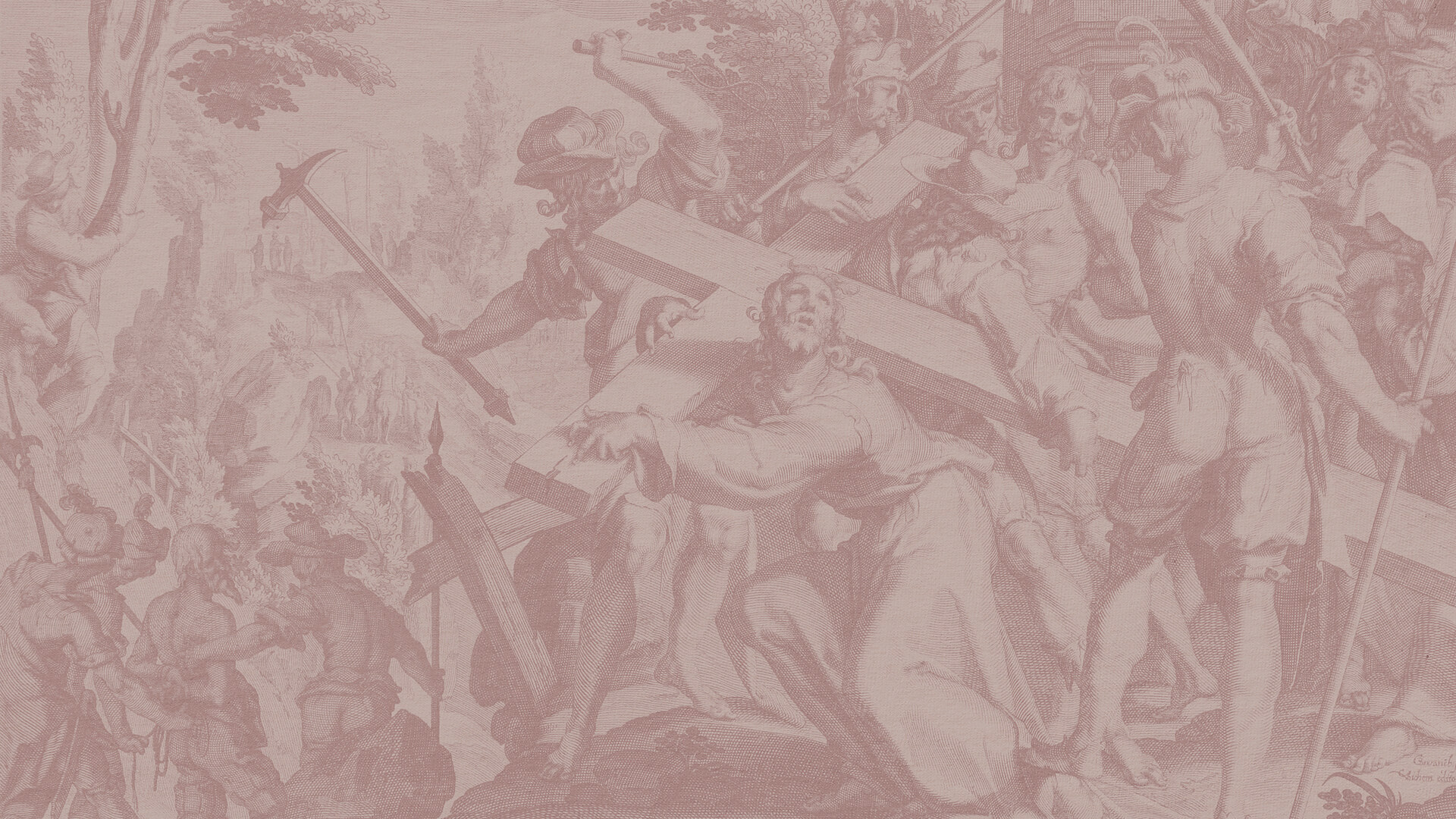
Simon of Cyrene is one of those fascinating Gospel figures about whom we know very little. He shows up right at the end of Jesus’ life, wandering into a chaotic scene like a character that got lost in the wrong act of a play. In fact, he happens upon the most painful part of the whole story: Jesus’ journey to Calvary. It’s not apparent from the Scriptures that Simon had any previous encounter with Jesus, yet suddenly he finds himself shouldering the cross with Him. What was that moment like?
Karol Wojtyla (Pope John Paul II) wrote a remarkable piece of poetry, Simon of Cyrene, exploring this very question. Wojtyla’s profound opening lines put us immediately in the sandals of the Cyrenian passerby:
“Eye to eye with this Man. The street. Many faces.
Pounding in my temples as a forge.
Nothing adventurous for me. I don’t want to offend;
let me keep myself for myself.
No beggar or convict will ever break into me;
neither will God.”
Simon of Cyrene is often mentioned in meditations about helping to carry the Cross with others who are suffering, and this is certainly a beautiful point of reflection. However, I propose that Simon is also someone who can teach us something about a particularly painful kind of suffering: scrupulosity.
Without wandering too far into the weeds, we can understand scrupulosity as a religious form of an obsessive and compulsive way of relating to others. For the person tormented by scruples (and there are many, including some who are now saints!), there arises a constant need to check and reassure oneself that nothing is missed when it comes to religious practice or in one’s relationship with God. For example, this person might find themselves returning to the Confessional again and again, multiple times in the same week — just in case that one thing was not confessed in the right way, using the right words. “I need to make it clear to the confessor exactly what I meant, because otherwise maybe that particular confession was not valid. I don’t think I said that right. What if he thought I meant something else? I just need to make sure…”
The roots of scrupulosity can often be traced back to having a parent whose affection changed, even in subtle ways, according to one’s performance. In this kind of relational dynamic, the child might start to feel that certain boxes must be carefully checked in order to gain and maintain parental approval. Soon, a protective part can emerge that hyperfixates on fulfilling precisely what is being asked or expected. The safety of a relationship of unconditional love that persists even when mistakes are made is replaced by an uncertain world where love must be earned in accord with the preferences of the other.
What does any of this have to do with Simon of Cyrene? In his poem, Wojtyla suggests that Simon could be understood as a somewhat legalistic man. Simon might see the value of helping Jesus, but only from the standpoint of justice, rather than from a perspective of love. He agrees to carry the cross as a way to:
“bargain with you bullies
over that Man
(though I would rather be back in town).
I bargain for justice…”
Simon doesn’t want anything too “adventurous” to break through his black and white way of thinking. Maybe if he sticks strictly to what is being asked, he can carry the cross, check the box, and move on with his day, satisfied that he did his duty and performed well. Likewise, when a person operates out of a scrupulous part, life and relationships can be reduced to a similar set of boxes to check. While scrupulosity can be agonizing in a way that Simon’s legalistic mindset might not be, the two share a similar pitfall: potentially avoiding a true encounter with Jesus, who is Love and Mercy himself.
Wojtyla undoubtedly understood the power of this kind of merciful encounter. He highlights this in the middle of his poem, describing an imaginary moment when the weight of the cross knocks both Jesus and Simon to the ground. Perhaps we can view this fall as Simon’s (and each of ours) inevitable confrontation with his own weakness. Compelled to carry the cross, Simon set out to do his duty — and yet he did it imperfectly. He fell. Yet from this fallen position, Simon suddenly glimpses something new: the eye and the heart of Jesus.
“An eye hangs above me, rays pour from the heart;
higher than the cross-beam,
the eye is so high I can’t reach it.”
In this unexpected personal encounter, Simon’s heart begins to change. True, alone he “can’t reach” the eye of the One that sees him, but this eye belongs to a God that bends down to Simon instead. Laws, rules, regulations, and even check-boxes undeniably have their place, but not when they are viewed apart from the Lawgiver who is Love. In the face of Love and Mercy, Simon finally understands his own narrowmindedness:
“My petty world:
justice squeezed out, rules, regulations.
Your world is so big:
the eye, the cross-beam, and he….
No, I don’t want merely to be just.”
Perhaps you have a part that relates to Simon of Cyrene. Perhaps your own relational scars leave you feeling that the world is safer if you focus solely on God’s commands, making sure you scrupulously check the boxes and don’t mess up. The anxiety surrounding this kind of interior experience can be crippling and a deep source of pain and suffering. The road to a new way of relating might seem impossible. In this place, maybe Simon of Cyrene is your man.
Simon set out to accomplish a task. The Gospels tell us he was “compelled” to carry the cross, and Wojtyla helps us imagine that this task was not accomplished perfectly. However, a scrupulous focus on perfection was never the expectation. Rather, the invitation was to follow Jesus into a new world where the eternal response to our inevitable imperfection is Love.
Simon reminds us that maybe what we need is not more safety, but more trust in moments of uncertainty. He teaches us what can happen when we step into the adventure life presents, rather than simply check boxes or “keep myself for myself.” Finally, Simon shows us that maybe love is not earned after all, but offered freely, precisely when we find ourselves on the ground, under the weight of the cross, with Jesus Himself.