

I’ve had Matt Maher’s song “Wait” playing on repeat this summer. As much as I love the song, I’m equally captivated by his lyric video. Scene after scene of an integral human experience: waiting. In the laundromat, on the subway, at the crosswalk, in your seat at the movie theater, during a bumper-to-bumper traffic jam, as icicles melt, while seedlings sprout and grow, as dawn breaks…
Each scene elicits a familiar yet uncomfortable feeling in me: longing mixed with both hope and uncertainty. I reflect on the things I’m waiting, praying, longing for in my life – desires unfulfilled and dreams to which I stubbornly cling. We all have them, big and small. I bet you have more than one coming to mind right now. Your next day off. That health issue to resolve. The moment the “one” finally comes along. The second school gets out – or starts. The big promotion at work. That deeper conversation that finally gets beyond the superficial. The day you buy your forever home. Relief from the darkness or struggle or emptiness or fear inside. That loved one’s conversion. Your own conversion.
Why is waiting on the Lord so uncomfortable? One reason I find is that it reminds me that I am not ultimately in control of everything. In other words, I am not God. Waiting on His timing and His response is hard. Really hard. And the deeper the desire, the harder it is to wait. It’s in that difficult space that we’re faced with a few options: attempted control, bitterness and resentment, or surrender.
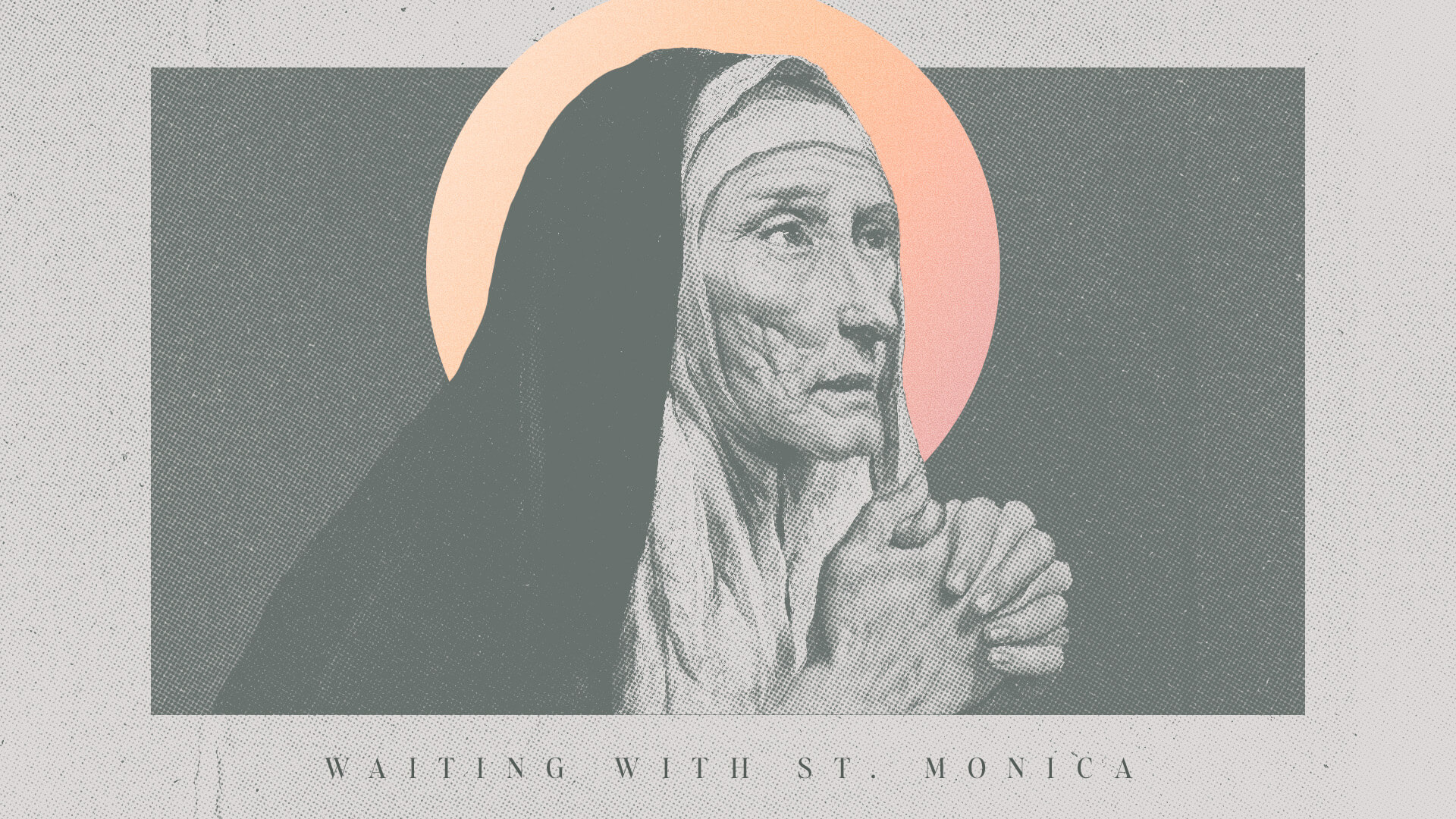
St. Monica was well acquainted with waiting. Along with fervent prayers for the conversion of her pagan husband and mother-in-law (both of whom were baptized before their deaths), she fasted and prayed for the conversion of her son Augustine for seventeen years. Seventeen years!
Much of what we know of Monica’s story is related by this same “son of so many tears.” I admit that I smile when I think of the creative ways Monica tracked her son throughout his travels, despite his futile attempts to sneak off without her knowledge. Perhaps I find it comforting to witness her own human struggle to let go of control.
In his Confessions (5:8), St. Augustine also recounts that Monica “wept and wailed” when he was absent from her, as he stumbled along the winding road to his ultimate conversion. I don’t know about you, but I can definitely recall my own sessions of weeping and wailing. Often in those desolate moments, the same old questions arise: Why? How long? What if? I wrestle with not understanding, with comparing my lot to others, with attempting to somehow control the details or persons involved, with trying to figure out any possible way around the discomfort of waiting. Often, I start to get that bitter feeling that comes when I try to shut down my desires and say, “Fine! I don’t care anyway!” Even though I do care. A lot.
St. Monica chose another way. Her sanctity tells us that at some point (or more likely, at many points) along the way, her attempts at control, and painful weeping and wailing, gave way to surrender. From the depths of her maternal concern, and deep desire for Augustine’s ultimate good, she placed her trust in the Lord. I find it astounding, as well as fitting, that today her relics are housed in the Basilica di Sant’Agostino in Rome, a church dedicated to the restless son who once caused her so much unrest. In the Confessions (9:10), Augustine recalls the moment he reveals his conversion to Monica:
When we related to her how it had happened she was filled with triumphant delight and blessed You, who have power to do more than we ask or understand, for she saw that You had granted her much more in my regard than she had been wont to beg of You in her wretched, tearful groaning.
Surrender includes trust that we have a good Father who hears us and has the power to “do more than we ask or understand.” His answers do not always come in the shape we want, or when we want, but they come. When we loosen our grip and let go, He expands our hearts and purifies our desires and invites us into a new kind of intimacy that is only borne from suffering and love. The process of surrendering is freeing – but painful. Or, as another saintly woman, Mother Teresa, bluntly describes it: “It sounds nice but in reality it is not so easy.”There are places in our hearts that we are being called to surrender today. Yes, today. There are desires that we long to have fulfilled, dreams and unanswered prayers for which we wait. Maybe you’re wrestling with control, with resentment, or simply with the ache of waiting. St. Monica is here to wait with you, to pray with you, to weep with you, to encourage you, to help you surrender. Sometimes we have to wait, but we never have to wait alone.
Thanks for this beautiful reflection! Waiting with hope , surrender and Trust! ( For sure not a easy journey but a one of consolation knowing that all will be well with our Lord beside us!)
I liked your reflection, Kirsten. You expressed it so well.
Beautiful and profound reflection that is applicable to everyone!